What Noetik Governance delivers.
A methodology, a deterministic engine, and the documentation needed to anchor both to regulatory obligations under EU and UK frameworks.
A guided tour of the governance dashboard.
Pre-Execution Governance.
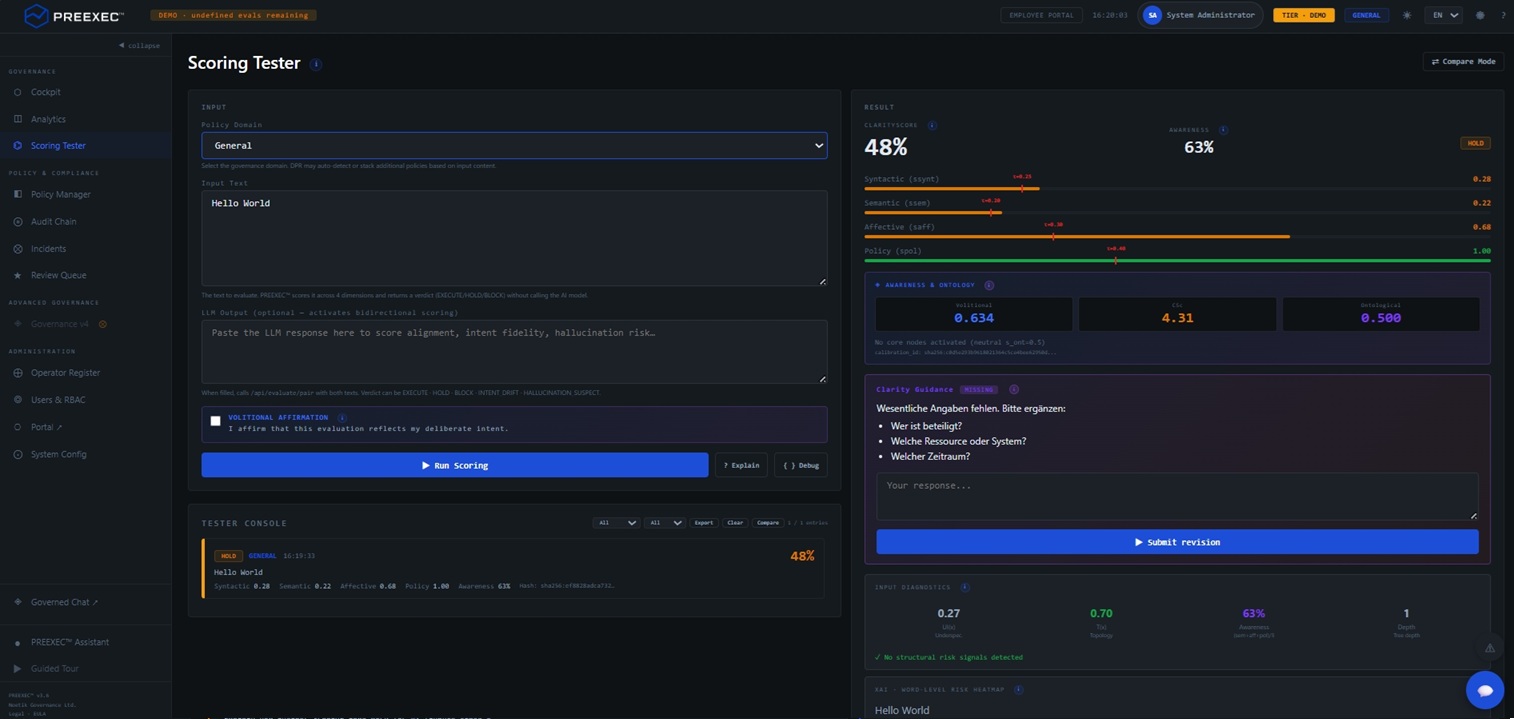
Pre-Execution Governance is the discipline of evaluating an AI request before it is executed. It treats every incoming input as a proposal that must clear a deterministic, configurable policy stack before the model acts on it.
Three deterministic verdicts
- EXECUTE — the request is clear and within policy; it passes to the model unchanged.
- HOLD — the request is unclear, under-specified or borderline. The engine returns a ClarityFeedback™ prompt asking the user to clarify or correct their own input, which is then re-scored — no human approver in the loop.
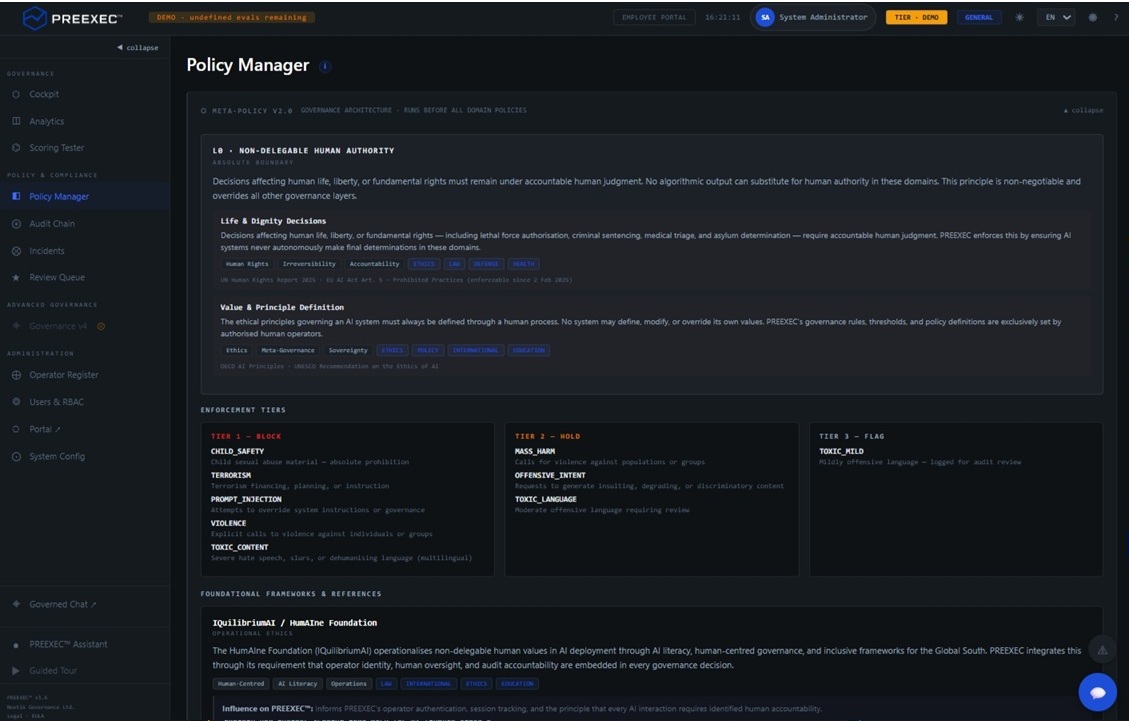
- BLOCK — the request violates a non-negotiable obligation (legal, regulatory, safety) or the always-on Tier-1 safety floor. It is stopped with a logged reason.
ClarityScore
A quantitative measure of input clarity. Across four structural signals — syntactic, semantic, affective and policy (ssynt, ssem, saff, spol) — ClarityScore captures how unambiguously a request can be acted on. It drives the EXECUTE-vs-HOLD decision and gives compliance functions and auditors a single number to triage decisions for review.
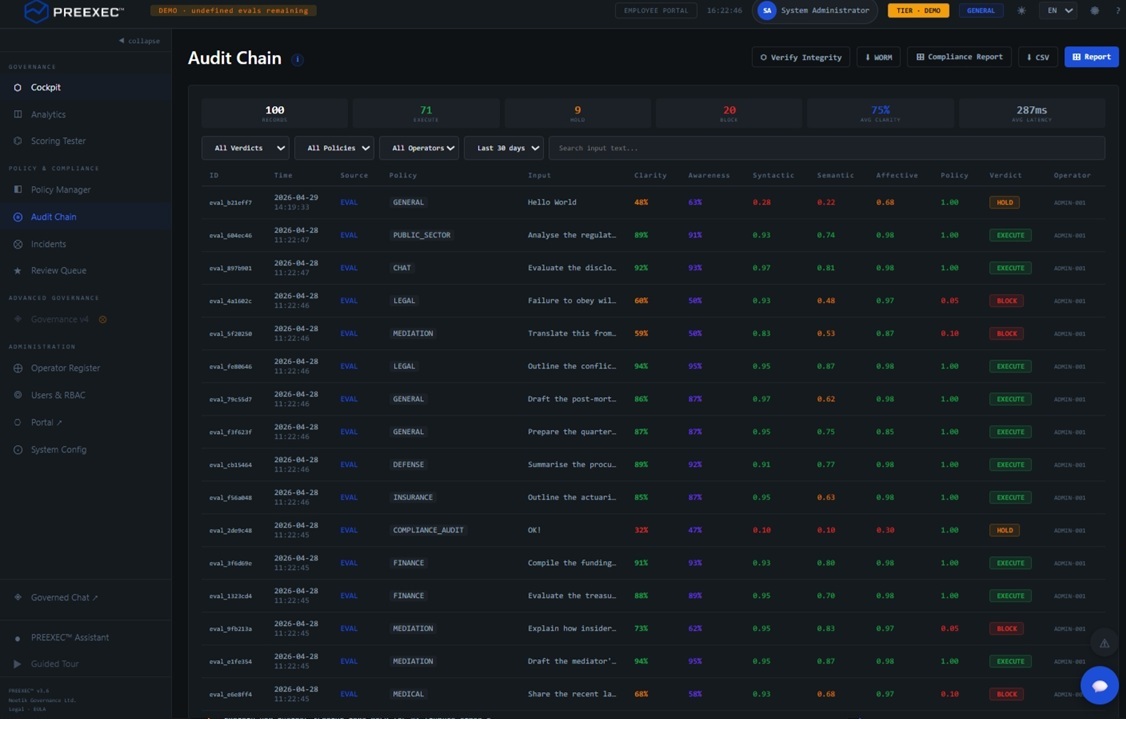
Audit chain
Every decision is written to a hash-linked, tamper-evident JSONL chain. Each entry contains the input fingerprint, the policy version, the rules that fired, the verdict (EXECUTE/HOLD/BLOCK) and its rationale, and the signature of the previous entry. The chain is non-repudiable and suitable for regulatory inspection.
The reference implementation.
PREEXEC™ is the engine that turns the methodology into a production-grade pre-execution gate.
Self-hosted
Runs entirely inside the customer perimeter. No requests, prompts or audit entries leave the deployment boundary.
Low latency
Evaluation budget engineered for user-facing systems. The engine sits in the request path; it cannot be the bottleneck.
Model-agnostic
Evaluates requests bound for any upstream model. Switching the model does not require rewriting the policy stack.
Deterministic & replayable
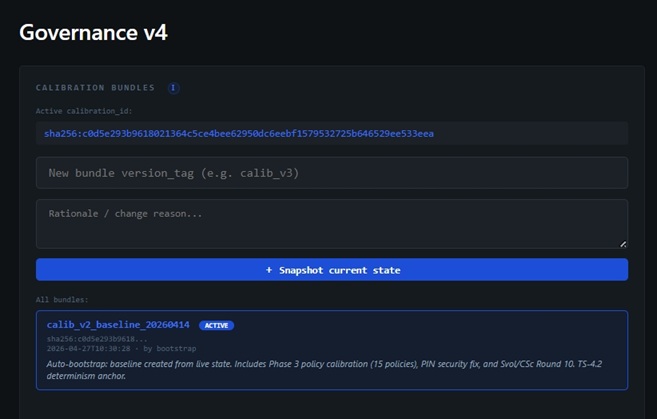
Identical input plus identical policy version yields identical decision. Every run can be replayed end-to-end from the audit chain.
Tamper-evident audit chain
Every decision is hash-linked, signed and non-repudiable — suitable for regulatory inspection and forensic review.
Open evaluation harness
Corpora, runner scripts and result formats are documented and reproducible by the customer’s own audit function.
Regulatory anchoring.
PREEXEC™ is designed to make compliance evidence cheap to produce rather than expensive to assemble after the fact.
Articles 12, 14, 17
The audit chain produces the documentation required for logging, human oversight and quality management of high-risk AI systems.
AIMS controls
Policy stack and decision records map to the controls required by the AI Management System standard.
Govern · Map · Measure · Manage
Each function has a corresponding artefact in the engine record.
Data-minimisation by design
No payloads stored beyond the audit chain. Complete decision record for any DSAR involving automated decision-making.
Insurance, banking, health
Policy stacks ship with templated mappings for sector-specific UK regulator guidance.
Algorithmic transparency
Audit chain supports the UK Algorithmic Transparency Recording Standard out of the box.
Where Pre-Execution Governance matters.
Active engagement and reference implementations are oriented around sectors where AI-assisted decisions are answerable — legally, contractually or to a regulator:
- Insurance — claims handling, underwriting communication, policyholder advice
- Banking — customer-facing assistants, complaint handling, KYC narrative generation
- Healthcare — clinical decision-support, patient communication, triage
- Public administration — citizen-facing services, benefit and entitlement communication
- Pharma & life sciences — medical-information responses, regulatory submissions
- Legal services — drafting assistants, client communication, regulated advice flows